 1. Context of Vietnam’s Tourism Industry
Tourism is playing an increasingly important role in the economic development of countries and territories. With advantages in abundant natural and cultural resources, this “smokeless industry”, together with several supporting service sectors, is gradually occupying a strategic position in Vietnam’s investment and development priorities. In practice, tourism is a composite business sector that encompasses many different service-provision activities. In order to generate greater tangible economic, political, and social value for the country, as well as to help unlock the potential and comparative advantages of tourism resources in each locality, human resource development must be placed at the center of tourism planning and development programs.
The Resolution of the Eighth Plenum of the 12th Central Committee on the Strategy for Sustainable Development of Vietnam’s Marine Economy to 2030, with a vision to 2045, clearly states: By 2030, Vietnam will successfully and decisively develop marine economic sectors in the following order of priority: (1) Marine tourism and services; (2) Maritime economy; (3) Oil and gas extraction and other marine mineral resources; (4) Aquaculture and fisheries; (5) Coastal industries; and (6) Renewable energy and emerging marine economic sectors. Accordingly, the strategic priority is to develop marine tourism and services with specific focuses: prioritizing investment in tourism infrastructure; encouraging and facilitating all economic sectors to participate in developing ecotourism, scientific exploration tourism, community-based tourism, and high quality coastal resort tourism in coastal areas; building and diversifying products, product chains, and world class marine tourism brands on the basis of conserving biodiversity, promoting the value of outstanding natural, cultural, and historical heritage of each region, and connecting international tourist routes so that Vietnam becomes an attractive destination for the world. At the same time, it is necessary to research and pilot tourism development on islands and in offshore areas; strengthen search and rescue capacity; promote scientific exploration activities; and place emphasis on marine education and healthcare. Support and favorable conditions should be provided to help coastal residents shift from occupations that pose risks of harming or negatively impacting the sea to activities that protect and conserve marine resources, thereby creating sustainable livelihoods, stable new jobs, and higher incomes for local people.
The Strategy for Development of Vietnam’s Tourism Industry to 2020, with a Vision to 2030, affirms the goal of making Vietnam an attractive and high class destination in the region, and of developing tourism into a spearhead economic sector characterized by professionalism, synchronous and modern technical infrastructure, high quality tourism products with strong brands and competitiveness, rich in national cultural identity and environmentally friendly.
Under this development orientation, Vietnam’s tourism industry places high demands on its human resources in terms of educational level, professional skills, and management capabilities, as well as requiring sophistication and sensitivity in tourism business operations.
2. Context of Tourism Human Resource Training in the South Central Coast
The tourism development master plan for the South Central Coast specifies that, given the region’s characteristic of coastal resort tourism, labor demand is higher than in other regions, with an estimated 1.4 to 1.5 direct workers per hotel room, and one direct worker accompanied by 2.0 indirect workers. Accordingly, the total labor demand for the tourism sector in the South Central Coast by 2030 is projected at about 230,000 direct workers in tourism and 470,000 indirect workers in society. This is considered a significant opportunity for developing tourism human resource training in the coming period.
In practice, the South Central Coast has a relatively developed system of tourism training institutions. Currently, the whole region has 19 universities, 27 colleges, and 13 intermediate-level institutions, of which 9 universities (accounting for 47.4% of all universities offering tourism-related majors), 10 colleges (37% of all colleges), and 5 intermediate schools (38.5% of all intermediate schools) have tourism training programs, with a total annual intake of nearly 3,500 students and trainees (based on each institution’s announced enrollment quota). At the college and vocational intermediate levels, nearly 70% of all vocational training institutions are engaged in training occupations related to tourism, with around 4,000 learners annually. The total training scale of tourism training institutions at all levels is around 7,500 people, which is relatively low compared with the region’s tourism human resource needs.
Some training institutions are not yet specialized in tourism: Pedagogical Colleges in the region (which mainly focus on training in tourism foreign languages, tourism geography, and tourism culture rather than on such majors as travel business management, hotel management, or restaurant management), and vocational colleges and intermediate vocational schools (which provide tourism training at the level of professional secondary education and technical workers of grades 2/7 and 3/7). Localities such as Da Nang, Quang Nam, and Khanh Hoa have a number of training institutions that relatively meet the sector’s needs. However, some provinces such as Quang Ngai (with no tourism related training institutions), and Phu Yen, Ninh Thuan, and Binh Thuan (each with only one institution offering tourism majors) still lack sufficient training capacity. As a result, the capacity and quality of specialized tourism training in the South Central Coast remain limited and have not fully met the tourism human resource needs of the region in recent years.
In Khanh Hoa province, there are currently four higher education tourism training institutions at university and college level: Nha Trang University, Khanh Hoa University, the second campus of Ton Duc Thang University, and Thai Binh Duong University. In addition, seven colleges, intermediate schools, and centers offer tourism vocational training programs. Each year, these institutions train about 4,000 students and learners in tourism related fields. Among them, approximately 300 are undergraduate students, 1,200 are college students, and the remainder are at intermediate and elementary levels. The aforementioned gap between supply and demand offers considerable opportunities for specialized tourism training institutions to develop curricula and expand scale in order to meet labor market demand. At the same time, it poses major challenges in improving training quality and building a reputable brand in tourism training and research to compete with many prestigious institutions in the world and the region that are attracted by the training market and may establish campuses in Nha Trang–Khanh Hoa and in other coastal localities with strong marine tourism potential in the South Central Coast.
3. Formation and Development of the Department of Tourism
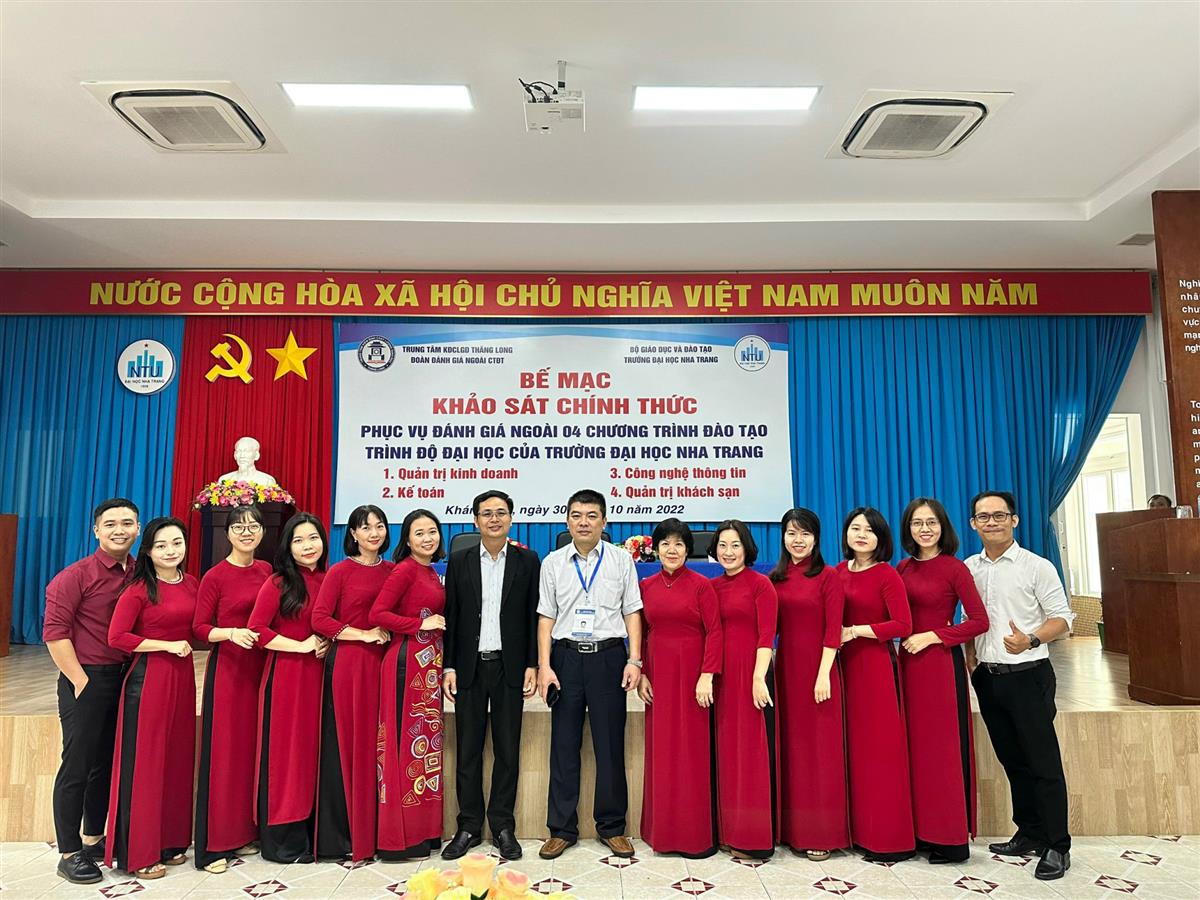
In 2006, Nha Trang University officially launched the Tourism Business Administration major. As the program grew, the Department of Tourism Administration was formally established in October 2010. Over 17 cohorts of graduates, the Department of Tourism Administration (formerly) has striven and gained confidence in supplying high quality tourism labor to meet societal needs.
Over the past five years, the number of students applying to tourism majors has increased, with entrance scores among the highest at the university in the academic years 2013–2014, 2014–2015, 2015–2016, 2016–2017, and 2017–2018. This is clear evidence of society’s trust in the university’s tourism training programs. To meet the growing demand for tourism training in society, the Department of Tourism – Nha Trang University was officially established by the Rector’s decision in January 2019. To date, the Faculty offers two training majors: Tourism and Travel Service Management (at undergraduate and college levels) and Hotel and Restaurant Management (at undergraduate and college levels). Since 2013, the Faculty has developed and implemented the Francophone International Program in Business and Tourism Management (at undergraduate and postgraduate levels) in cooperation with partner universities in France and with the Agence universitaire de la Francophonie in the Asia–Pacific region. At the same time, the Faculty has regularly offered short term training courses for learners to enhance tourism skills and competencies in professional practice (such as tourism operation management, tour guiding, and, in the future, housekeeping, food and beverage service, and hotel–restaurant management).
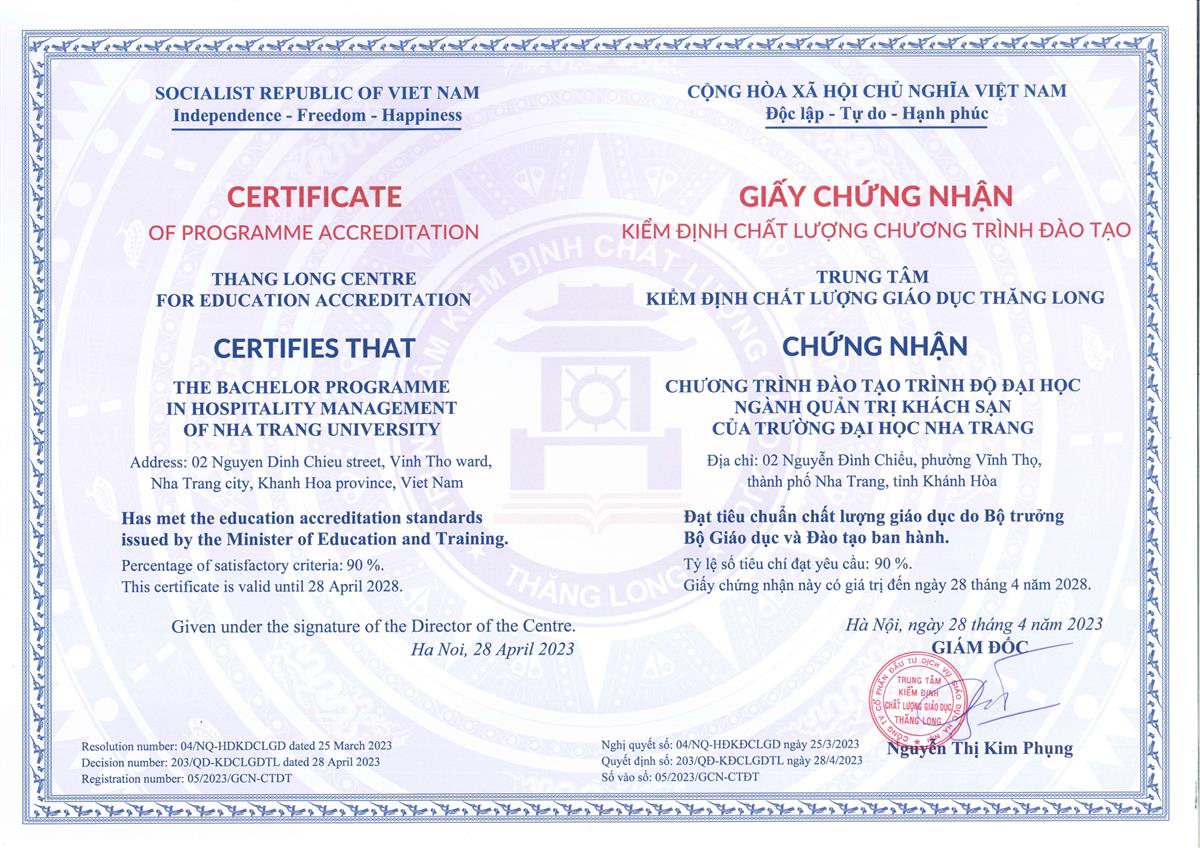
On April 28, 2023, the Bachelor’s Program in Hotel Management (Department of Tourism – Nha Trang University) was recognized as meeting the quality standards for undergraduate programs and was granted a program accreditation certificate valid from April 28, 2023 to April 28, 2028, with 90% of the criteria satisfied.
 4. Strategic Orientations of the Department of Tourism
- Strengthen the training and development of the teaching and research staff (with concrete plans and roadmaps to propose that the University continue to sponsor young staff to pursue doctoral studies in tourism, both domestically and abroad, and to recruit lecturers who are formally trained in tourism).
- Consolidate and enhance the quality of the Tourism and Travel Service Management and Hotel Management majors (oriented toward POHE – Profession Oriented Higher Education); expand training into such majors as Event Organization and Communication; develop bridging and second degree programs and move towards offering a Master’s program in Tourism Business Administration; consolidate short term training programs; and broaden 2+2 joint training models with reputable tourism training institutions worldwide.
- Further promote research activities by lecturers and students through proactively proposing and bidding for scientific projects at university, provincial, and ministerial levels, aiming to address practical issues facing marine tourism in Khanh Hoa and the South Central Coast.
- Further strengthen the development of textbooks and lecture materials (which are currently lacking in Vietnam in the field of tourism business), and develop specialized tourism monographs for teaching and research.
- Focus on collaboration with strong faculties and institutes within the university (such as the Faculty of Economics, Faculty of Accounting and Finance, and Faculty of Food Technology) to develop tourism and gastronomy related programs at undergraduate and postgraduate levels; and simultaneously increase coordination in teaching and research on fisheries–tourism linkages, which is currently a key strength of the University.
- Place greater emphasis on cooperation with tourism businesses, hotels, restaurants, and travel companies to create favorable conditions for students in internships, practicums, field trips, and employment opportunities; invite businesses to participate in teaching and collaborate in solving issues arising from tourism business practice.
- Seek and develop international cooperation activities in curriculum development and in implementing research projects related to tourism and the marine economy.